Conveyor-belt puzzle that tests reflexes and sorting accuracy
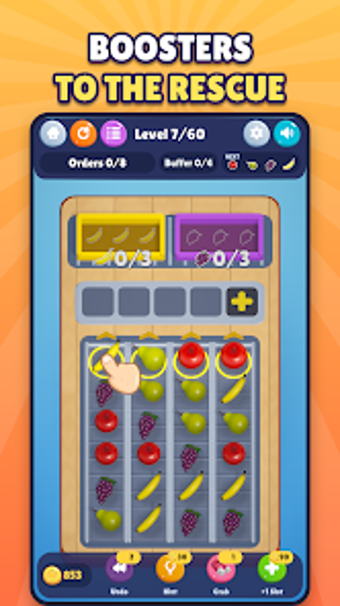
Sort different fruits on a moving conveyor: spot apples, bananas and cherries, then drop each into matching crates under time pressure. TiltShift, an Android-focused mobile studio, builds this casual puzzle around quick one-touch inputs and level-by-level scoring. The game highlights colorful, stylized visuals and short sessions, aimed at players who prefer fast reflex challenges and brief, repeatable play bouts rather than extended campaigns.
What the game asks you to do and how it plays out
At its core, Fruit Crates sets a single, repeating loop: fruits travel on a conveyor and you decide where each item belongs. The loop mixes reactive tapping with light categorization, so success depends on recognizing fruit types quickly and committing to a crate before the belt advances. Score tracking measures performance across levels, encouraging incremental improvement over repeated sessions.
How mechanics and modes shape short sessions
The game uses one-touch controls optimized for mobile, which keeps inputs simple during fast sequences. Levels increase in pace and fruit variety, raising cognitive load rather than adding complex systems. There are no mentioned alternate modes like multiplayer or campaign branches, so progression relies on level difficulty and higher scores rather than distinct play modes or cooperative options.
Visual clarity and mobile-oriented interface
Design focuses on bright, colorful fruit-themed graphics that preserve clarity when items move quickly. The interface reduces clutter, showing only the conveyor, incoming fruit, and crate targets, which supports quick decisions. Sound and music are not detailed in the source material, but the visual styling alone is presented as a primary tool to keep fast play readable.
Difficulty curve, progression, and replay incentives
Difficulty rises through faster conveyor speed and more fruit types, so the challenge scales by reaction demand rather than layered mechanics. Level-based scoring provides a clear replay incentive: players can aim to beat previous scores on the same map. The design targets short, repeatable matches suitable for casual sessions instead of deep, long-form progression systems.
Fruit Crates fits short-session players who prefer reaction puzzles
Fruit Crates rewards players who enjoy quick reflex tests and tiered level difficulty: scoring and faster belts push you to react and tighten accuracy. Some players seeking long-term depth or varied modes may find the single-loop design limiting, but for mobile sessions where clarity and speed matter, the game delivers a compact, focused challenge.